When I shared our recent journey to settling into our new home one of the things that most interested people was how the finances work. It is also the aspect of co-operative living that seems to present the biggest challenge to banks, government bodies and boomers alike.
In simple terms we are a fully mutual housing co-operative. This means that all of our tenants are members, and all of our members are directors/decision-makers. So while we do all pay rent, we also get a say in what the rent is set at (in our case Local Housing Allowance level) and how that rent is used. At the moment, because we have bought the property thanks to loans from individuals, most of our rent goes towards repaying those individuals over-time - much like you would a mortgage but with much lower interest rates, and in my opinion, less risk (which I’ll come back to later in the power of community).
These loans are called loanstock. When people sign up to invest in the co-operative they can choose their repayment terms and their interest rates - we’re repaying most investors over 5-25 years at rates between 0-5%. Members of the co-op can also invest loanstock - but it’s not a requirement for living here because we believe that access to cash shouldn’t determine access to secure and affordable housing.
Redistribution of resources
As a member of Radical Routes we adopted the premise early on that there is no equity attached to being a member of the co-op, and that membership is separate to any loanstock investment. Not only does this make co-operative living accessible to everyone, but it also means that members who have more money in the co-operative don’t have any more decision-making powers over the property and can’t simply choose to take their money out if they decide to leave.
This is fundamentally in opposition to what the capitalist market wants us to believe about the role of money and housing. We are taught that money = ownership. We are taught that ownership of a house can lead to profit. But in a co-operative setting your money is simply being utilised to enable others without the same wealth to access secure housing. It is a form of redistribution. You can eventually get your money back but not through selling the property out from underneath other members (which is what occurs in standard landlord situations). And eventually our hope with the Wirksworth Housing Co-operative is that we will pay off all of our loans and the property can continue to exist as affordable housing within the community forever - even if the original members decide to move.
The right to security
One thing that’s been disconcerting about the conversations we’ve had with people is that it’s not just landlords and individuals that own their own houses that struggle to get their heads around the idea that members don’t have to ‘buy in’ to the house. The DWP have also found it challenging to understand that members don’t necessarily have to pay a deposit and won’t immediately be evicted if they fail to pay their rent. The fact that members all have equal say and can come together to make financial decisions has been used against multiple housing co-operatives as a reason for why they should be declined Local Housing Allowance. Which is basically suggesting that the government would prefer it if immediate risk of homelessness was inherent in any housing provision.
While a housing co-operative feels like an obvious way to live and use resources in my mind, in a capitalist system which wants you to be profit-centric rather than people-centric, creating this basic level of equality and security for everyone is an incredibly political act. And sure we might decide that some members aren’t right for the co-operative for all sorts of reasons, and if someone consistently wasn’t paying their rent it’d only be so long that the collective could swallow those extra costs while we have debtors that we owe. But that should be a collective decision, where everyone understands the risks and holds each other to account when we make decisions that affect each other's lives. The UK system is built on the idea that access to money is required to buy you security, and it also buys you out of accountability - wealthy people can buy up property and sell it for profit without any regard for how that affects other people’s affordability, landlords can sell off property as they wish without much consideration for their tenants lives, but if a tenant misses one rent payment the eviction process can be triggered.
The problem with banks
So I’ve shared some aspects of our finances when it comes to rent payments, and that members don’t have to ‘buy in’ to live at the co-op - so how did we actually raise £250K to purchase our property without the help of a bank?
In many ways we were forced into this route as there is really only one bank that currently loans to co-operatives - Triodos. The lack of banks supporting housing co-operatives to purchase a property is a whole other blog post, but in this instance we couldn’t access a bank loan from Triodos because the building was listed and being sold by auction, and also because their interest rates were too high to make our rents affordable.
In our set up just under 50% of the money came from members. That money was a result of a few members having previously owned property with ex partners and receiving equity when they sold those houses (we don’t feel good about having been part of that system historically, but we are glad to be able to take capital out of that system and invest into a more equitable one). But this all presents a substantial issue within the housing co-operative world. Those that most need access to secure housing are unlikely to have the same level of access to cash as we did between us. And if you can’t rely on a bank, and individual members don’t have access to cash, how do you raise enough money?
Cyclical funding and mutual aid
This is where Radical Routes has played a key role for many housing co-operatives to date. Radical routes currently has over £1.5million loaned or committed to 28 member co-operatives, and need to raise at least £500k a year in order to continue servicing the demand from currently unhoused co-ops. About £13k of our loanstock also came from members of radical routes, who have received loanstock back from their co-op and want the money to keep being recycled.
This is something our co-operative members also aspire towards. As Wirksworth co-op repays it’s loanstock over the coming years we hope to be able to make collective choices to reinvest some loanstock from members into supporting other co-operatives. This is how money can be used and recycled to multiply real world value, rather than left in property and banks to simply multiply interest and profits.
Moving more money from a cumulative profit-hoarding system into a cyclical system built on mutual aid is fundamentally systems changing. Even those in the philanthropic world aren’t ensuring that money is flowing continuously. Funders are often sat on billions of pounds that is slow to move out into charitable and community projects in the first place, and when it does eventually get given to organisations as grants both the restricted nature of it (where funders dictate what the money can be spent on) and the fact there is no expectation that the money is returned into the system in anyway means that much of it can disappear into the machine rather than materialising as real-world value. The radical routes model changes how we operate as a collective - yes co-operatives can access affordable loans from the network, but as members we are also repaying that and investing in a membership fee in order to ensure that more co-operatives can re-use that money in the future. Plus because the network is a co-operative, all of us have a say on how funds get spent and how to respond to more urgent matters (hence why our funds have flowed out much faster than they’ve flowed back in because we’ve chosen to keep prioritising supporting those who are struggling within a financial system that is stacked against them).
The power of community
But our journey to raising the funds we needed didn’t just rely on people who are already part of the co-operatives ecosystem. We raised £135,000 from our local community in Wirksworth within the space of 2 weeks. This was probably the most affirming and inspiring thing that has occurred in our whole journey of exploring the possibility of living co-operatively. Some of this investment came from people who know us well and have benefited from the community events we’ve run, but most of it came from people we only met through the fundraising itself. And there were three core things that made that possible:
A recognition that the local housing market is broken
During our fundraiser, Nick went to an event with Wirksworth Civic Society to talk about how co-operatives could change the housing market. It was attended by 50 people all discussing local issues from the problem with people owning airbnbs and second homes in the Dales and the Peaks, to the fact that many properties in the area are too small for families and too expensive for single people. What’s more with both an aging population and many young people needing to move out of the area for work and affordability, the idea of communal living as a source of support appealed to many.
A desire to see a heritage building revived
Another thing that stood in our favour is that we chose a building which had historically been a thriving church hall and community space but had been underused for many years. It was either a community-minded group like ours that took over the space, or it could be sold to people wanting to do private development on it to turn it into more individual dwellings. As shared in the last post we’ve already hosted many community events in the space, and we’re working with the Architectural Heritage Fund and local architects to come up with plans for the space that preserve its history and revive the space to be able to host more people for more purposes.
A commitment to and understanding of us as people
A few days before the auction deadline for the Glenorchy centre, one of our biggest investors was put onto us via the community farm I volunteer at each week. Already it was clear that we had shared values of supporting local businesses. When we met we had more in common around other beliefs such as how more neurodivergent and disabled people should have access to living set-ups where they both have independence and autonomy, alongside support and community. We chatted twice in the space of a few days before they decided to contribute £50,000, and to ask their friends for further investment.
Six of our investors were unknown to us prior to the fundraiser, and the value of that is immeasurable. To experience a community that can put their trust into us in this way injected us with even more energy and commitment than if we had managed to make this work entirely on our own, or with banks, or just with networks we are already part of. And in return it means that people who might not otherwise have known that this way of living was possible now get to experience first hand what happens when you believe in change.
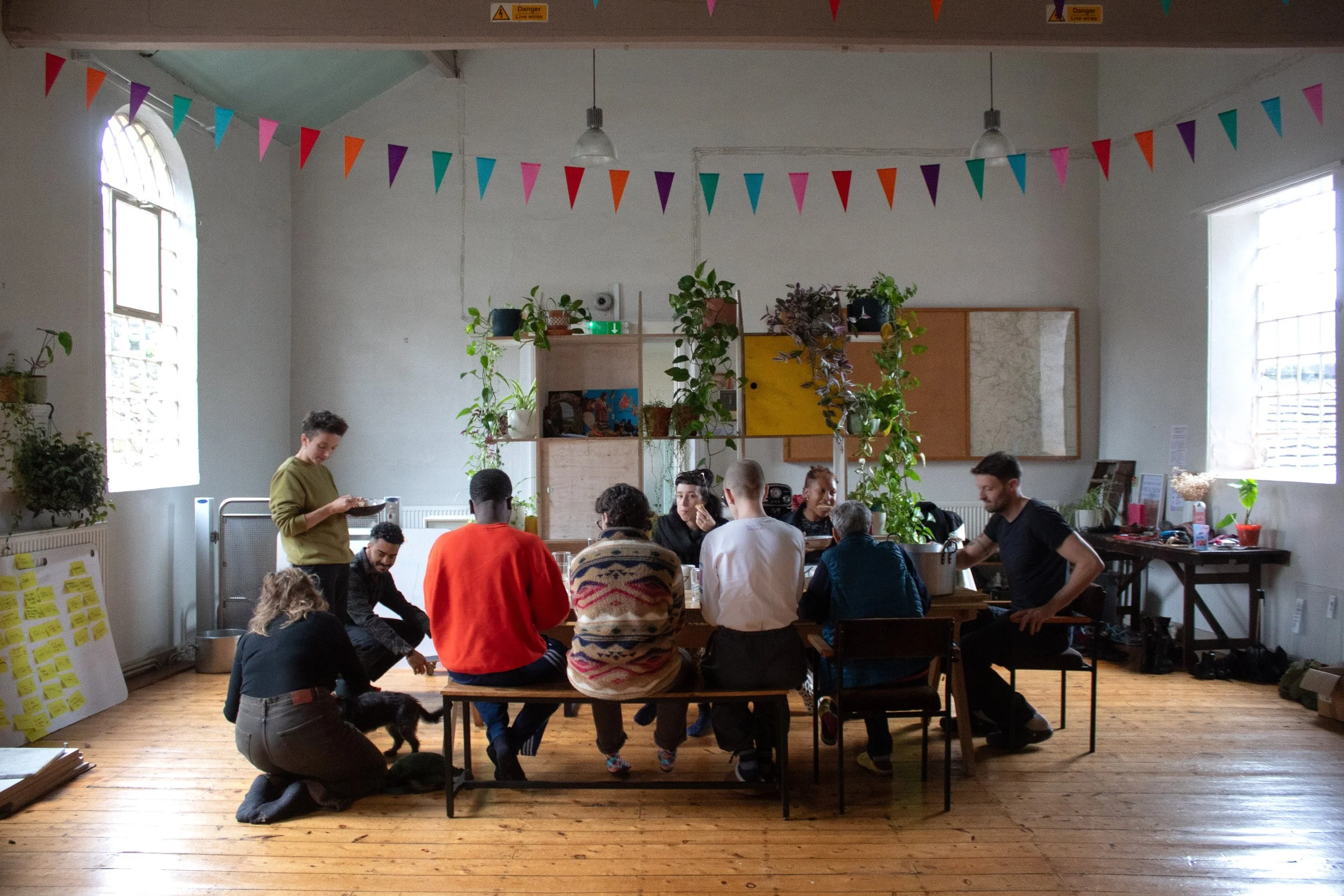
And as we navigate the systems that continue to be stacked against us, and the hard work that it’s going to take to make all of this work, our real sense of security comes from the fact that we’ve got a whole community behind us. We held a big house warming lunch with our neighbours and supporters and it was profoundly moving to know that all of those people would be there to help us out as we navigate unknown terrain. And even when people haven’t been able to invest financially they’ve invested their time - from chipping in to DIY, to hosting events in the space and contributing to ideas for the future.
If you want to learn more about the co-op and our journey, or are interested in investing in us or Radical routes, get in touch with me on ray@and-breathe.org.