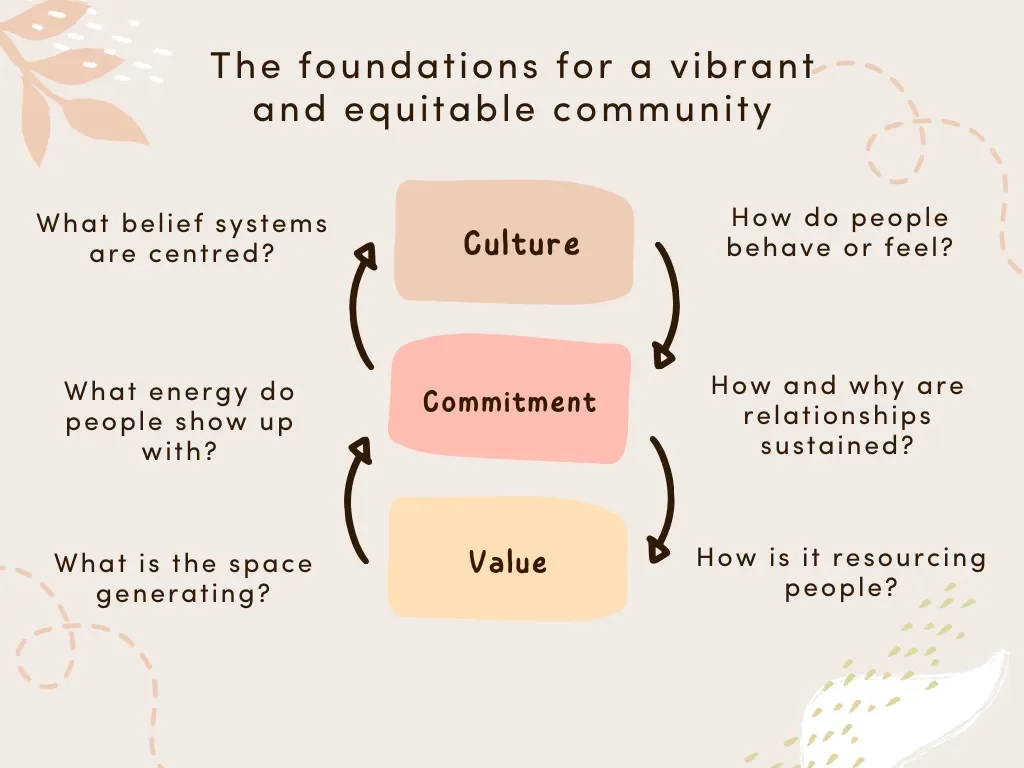
A diagram titled “The foundations for a vibrant and equitable community”. It has three core principles at the centre - Culture, commitment and value - and questions such as “What energy do people show up with?” and “How and why are relationships sustained”
I wrote most of this post about a year ago, as part of working with a few different networks and organisations to support them with community work, and growing frustrated at people who think community can be accessed or created simply by putting people together in a room or online platform. Since then my experience of community has deepened. This past year my polycule and co-parenting community has grown, I’ve moved into our housing co-operative, I’ve run a queer care collective, I’ve facilitated multiple community research groups, and my professional community has grown exponentially too thanks to the holding space series.
But I still meet people who want to magic a community for themselves or their organisation without understanding what it truly requires. As ‘community’ becomes an increasingly overused term in both the virtual and physical world I fear that community-building and community engagement work is being done poorly by people raised in a capitalist society built on individualism.
When I was 19 I was living in a flat share in London and predominantly hung out with friends from my work. It was only when I got seriously ill and had to call on the distant cousin of my dad for support that I realised how isolated I was. It took me a long time, though, to realise that what I was missing was community, because it wasn’t ingrained into the fibre of my being.
I’d grown up with a makeshift community my mum had built around us - 4 working mums taking it in turns to look after all of the kids. But we were working class families striving for a middle class existence. As a result the need to rely on each other was experienced as a failing or a survival tactic rather than the essence of our collective life. Beyond that group and my immediate uncles and aunties, I hadn’t experienced the same depth of community support that I feel I have access to now.
I’m sad to say that I had my first real embodied experience of community didn’t happen until I moved to Nottingham when I was 27. There, I not only experienced a community based on proximity - kids running between the terraced houses we all lived in, local cafe owners knowing everyone’s regular orders, all watching out for the people we knew were more vulnerable - but I also connected to the ‘queer community’ for the first time. I’d understood myself as pansexual since I was a teen but I had no idea how much deeper queerness ran within me or how important it was to be surrounded by people that aligned with my soul.
Nottingham was also where I first pursued building my own community through Collaborative Future. And while I didn’t necessarily have an accessible blueprint for community in my body, what I did have was a commitment to something other than the constant feeling of isolation and apathy, knowing that I needed it as much as anyone else.
This brings me to the first vital thing for true community-building: commitment. A major problem within the charity sector and many of the academic research teams I’ve worked with is that the people doing the work are doing so through a do-gooding martyrdom lens, rather than a solidarity lens (much like I’ve described in my community research post). Which means that when the work becomes too much, it’s easy to let it go because you aren’t committed to that community like your life depends on it.
Community-building needs everyone to feel that their fight is my fight, that their poor health is my poor health, that their debt is my debt - and conversely that their success is my success, their joy is my joy. Only through that commitment can the true value of community can surface. For example, the amount of knowledge, ideas and resources produced and shared on Autistic Reddit is so much greater than any of the charities working in this space because autistic people are deeply committed to other autistic people thriving.
Commitment to community is sustained through the value that is generated. Many potential forms of value exist within communities, and in recent years the interest in community-building has risen among both commercial teams and third sector organisations because of the value it can generate. Commercial ventures might seek to capitalise on the data generated through online communities or on the influence that people have on one another within a community, while activist groups see community as a source of collective power for their particular movement. For me, though, communities fuelled by either of these forms of value often feel like they are missing the blood that pumps through their veins: a deep, mutual value that can only be experienced and embodied, not measured, quantified, or rationalised.
A community fueled by love, care, and mutuality possesses both practical resilience and an electrifying vibrancy, the true value of which only those who experience it can understand. When a friend recently shared how their Muslim community mobilized after a cousin died—cooking meals, holding space, and rallying around the family’s needs—I felt it deep in my soul. This image's energy lit me up because I have been lucky to experience a similar flow with many of my communities, bringing back this magical sensation. This is the life-affirming nature of a community that feeds and holds you to your core, even—or especially—when you are at your most vulnerable.
Of course, communities can become imbalanced, and this experience can come at a great cost when forms of power and dominance are at play. This is why the third ingredient to attend to when community-building is culture. Quite often the most resilient and profound communities are those which embrace a polyculture, while still aligning around core shared values. It is this combination of collectivity and individuality, symmetry and diversity that keeps a community in balance and centred. Accountability is possible because members of the community are connected through choice, not out of obligation or duty.
I have been able to nurture the culture required for community-building because I am surrounded by people who hold one another to account. In the housing co-op movement, we have a multitude of informal relationships to compare and contrast our most intimate decisions. In the holding space community, I am lucky to have found people who share the belief and desire to make good facilitation more accessible, committing to help adapt how we do things together. Within my friendships and the queer care collective, we bring structures into intimate spaces to help everyone redesign how we show up and proactively unravel the norms and expectations inscribed on us from birth. This brings me full circle to commitment. We can only create the required culture if we are committed to seeing things through: pushing ourselves to go deeper, challenging our assumptions, being vulnerable so others can show up, and repairing any ruptures that occur.
So if you are seeking to build a community it’s important to ask yourself: have I actually experienced what it means to be a part of a thriving community? And if not, how can I? If I can’t experience it elsewhere what commitment am I showing up to this community-building endeavour? Are the intentions behind building this community to generate mutual and life-affirming value for everyone involved, or is there anything more one-sided at play? What culture(s) are we going to embrace and centre within the community we build? How will that culture ensure the cycles of commitment and value generation continue among its members?